HOYTE, John Barr Clark;
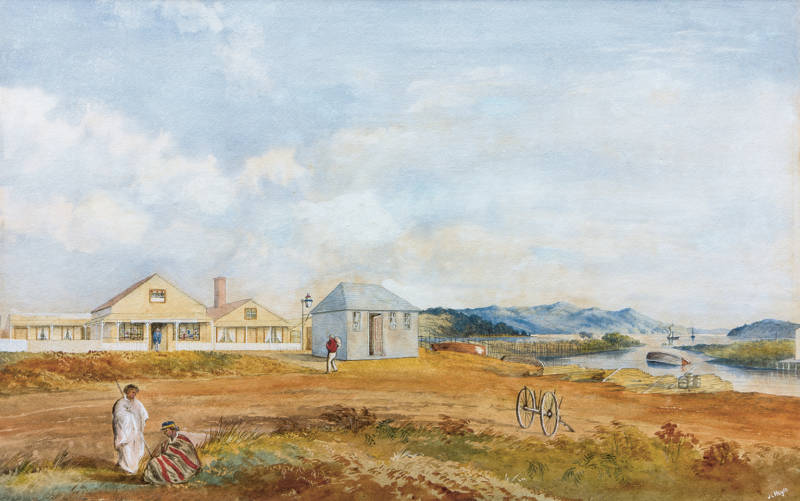
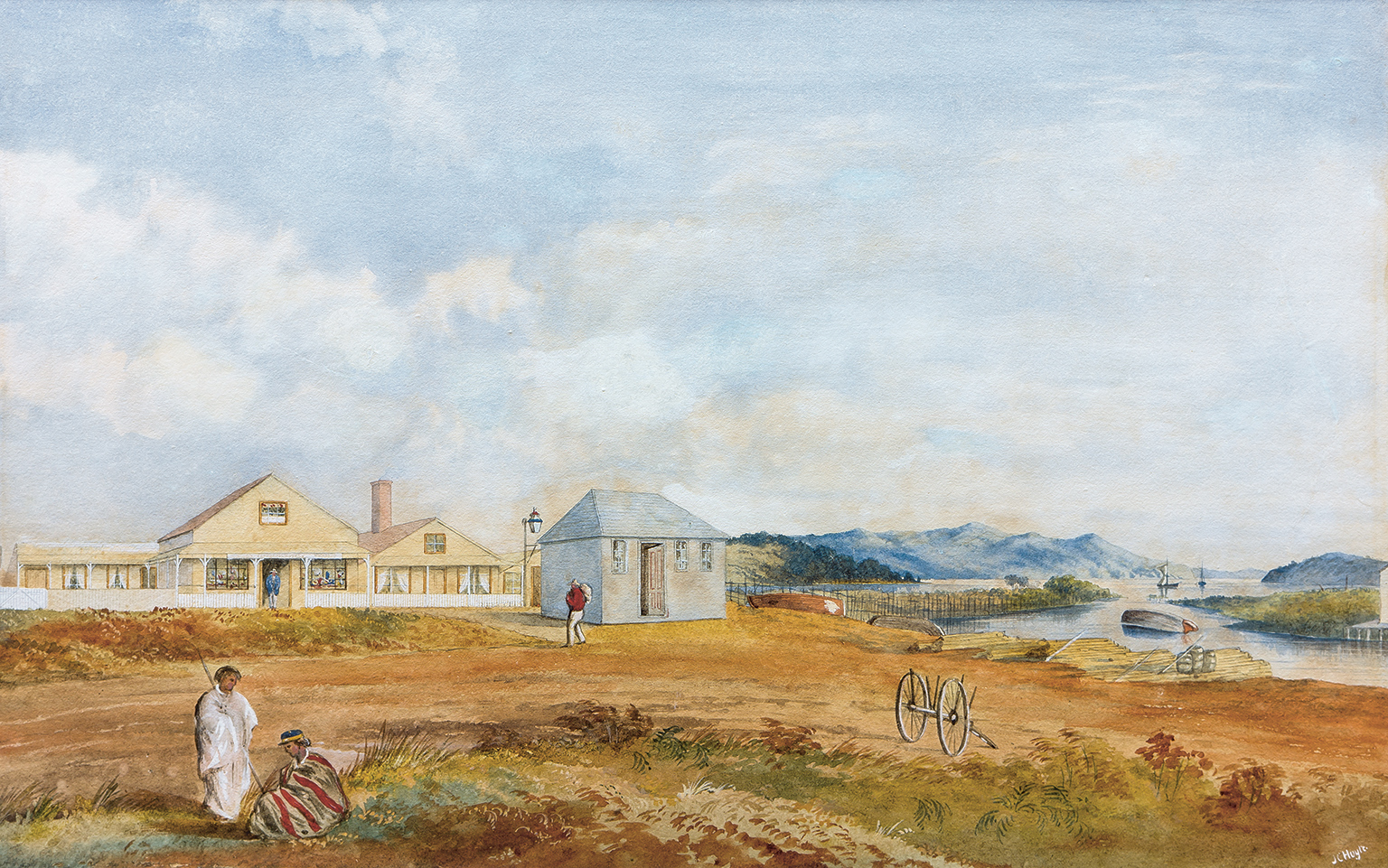
Commercial Hotel, Coromandel
1868
Watercolour on paper
290 x 460mm
John Barr Clark Hoyte was born in England and lived in Aotearoa from 1860 to 1879. An energetic and enterprising artist, he travelled widely in search of subjects for his precise watercolours, recording dramatic landscapes, economic activities, and growing colonial settlements with equal enthusiasm.
Hoyte’s four works in the Fletcher Trust Collection depict the Coromandel area, which he seems to have visited on several occasions, and date to the late 1860s, when investment was increasing in connection with the mining of gold from quartz reefs. They were acquired in 1962, the first paintings bought by Sir James Fletcher and George Fraser for the collection.
This view shows the waterfront of the settlement of Kapanga, or Coromandel. It looks south towards Coromandel Harbour. Kapanga Creek (or Fureys Creek), part of Whangarahi Stream, is on the right. The landforms in the distance are Preece Point, Te Kouma, and possibly Whanganui Island. The painting forms a de facto pair with Tauranga Hotel, Coromandel, which extends the view to the right.
The Commercial Hotel—on the left and identifiable by its signage—appears in newspaper articles from 1865 to 1871. Throughout this period, it was owned by prominent businessman Frederick Woollams. It was occasionally used for meetings of mining companies, and, in 1870, it played host to the Governor of New Zealand, Sir George Ferguson Bowen, and wife Diamantina, Lady Bowen.[1]
In February 1865, the Commercial Hotel was damaged by a fire. This also affected the neighbouring property of Elizabeth Holloway and her husband, Francis Collin Holloway, a storekeeper who for a time operated a store out of the Tauranga Hotel, across the creek.[2] The Commercial Hotel was apparently on the more favourable bank. In an article from 1866, the ‘correspondent’ notes:
‘New houses and stores have been built or enlarged since I was there before [almost two years prior], and Mr. Woollams has really a very creditable establishment close by the landing. Unfortunately the public buildings are on the opposite side to the township, having been built in a Government swamp. … So the public buildings were run up in the swamp, and the public, except by means of a boat, by swimming, or wading when the tide served, could not have access to them.’[3]
[1] ‘The Governor’s Visit to Coromandel’, Daily Southern Cross, 17 January 1870, 4, https://paperspast.natlib.govt.nz/newspapers/DSC18700117.2.23.
[2] ‘Coromandel’, New Zealand Herald, 7 March 1865, 6, https://paperspast.natlib.govt.nz/newspapers/NZH18650307.2.24.
[3] ‘Gold Mining—Coromandel’, Daily Southern Cross, 28 April 1866, 3, https://paperspast.natlib.govt.nz/newspapers/DSC18660428.2.12.

Exhibition History
Tirohanga Whānui: Views from the Past, Te Kōngahu Museum of Waitangi, 15 April to 15 September 2017