HOYTE, John Barr Clark;
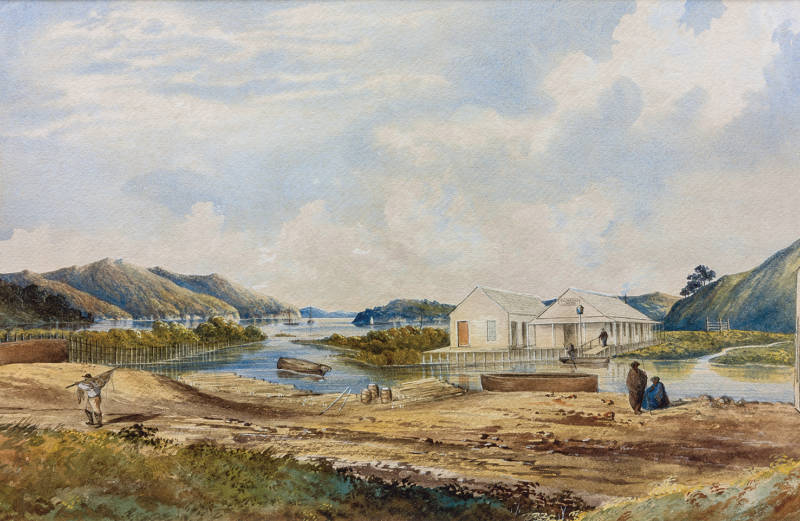
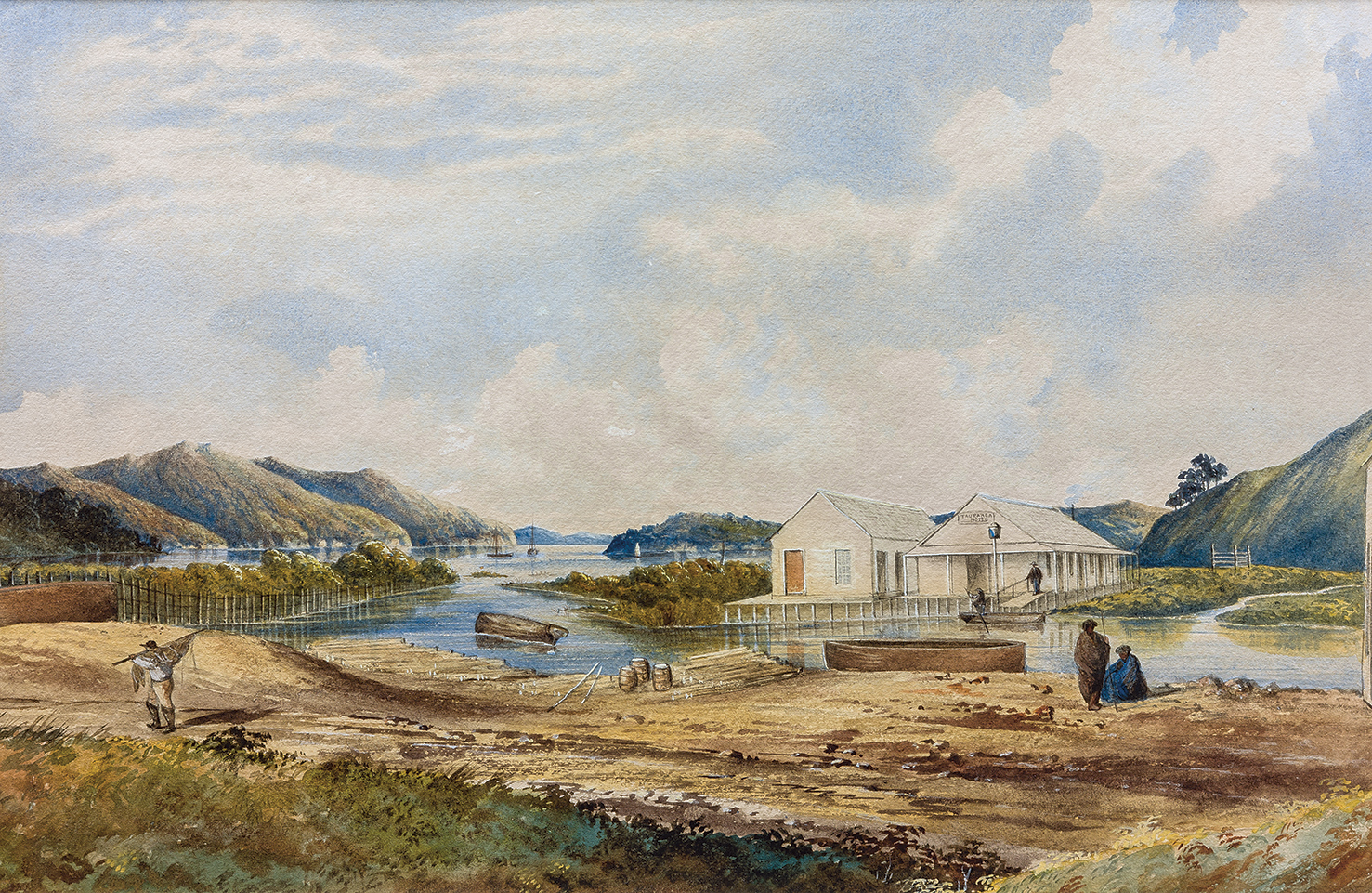
Tauranga Hotel, Coromandel
c.1868
Watercolour on paper
290 x 440mm
John Barr Clark Hoyte was born in England and lived in Aotearoa from 1860 to 1879. An energetic and enterprising artist, he travelled widely in search of subjects for his precise watercolours, recording dramatic landscapes, economic activities, and growing colonial settlements with equal enthusiasm.
Hoyte’s four works in the Fletcher Trust Collection depict the Coromandel area, which he seems to have visited on several occasions, and date to the late 1860s, when investment was increasing in connection with the mining of gold from quartz reefs. They were acquired in 1962, the first paintings bought by Sir James Fletcher and George Fraser for the collection.
This view shows the waterfront of the settlement of Kapanga, or Coromandel. It looks south, across Kapanga Creek (or Fureys Creek), part of Whangarahi Stream, towards Coromandel Harbour. The landforms in the distance are Preece Point and Te Kouma, on the left, and Whanganui Island, on the right. The painting forms a de facto pair with Commercial Hotel, Coromandel, which extends the view to the left.
The Tauranga (meaning ‘landing place’) Hotel was established by early 1863 and owned by Mr. R. Simpson. The documentary record suggests that it faced difficulties from the beginning. A robbery took place at the hotel in March 1863.[1] In April, the ‘new, commodious, well-built, and valuable Hotel’ was offered for sale through auctioneer Samuel Cochrane.[2] The advertisement noted:
‘The building is situated on Crown land (half an acre), held direct from Government, at a nominal rent, for a period of seven years. In it are contained 20 Rooms, Verandah, Platform, &c.; a Thurston Billiard Table, which cost £130; a punt, cost £6; and the Furniture and Stock to be taken at a valuation. The monthly receipts have averaged £180, and there is no doubt they can be increased 30 to 50 per cent. [sic] under proper management.’[3]
Evidently, the property did not sell, since Simpson remained the proprietor.
The site of the hotel was less than ideal. It was on swampy land, near to key public buildings, such as the magistrate’s court and post office, but separated from the township by Kapanga Creek.[4] There was no bridge across the waterway, and Simpson’s punt, which was ‘very frequently … half full of water’, was relied upon by those wishing to cross.[5]
Impeded access was apparently an ongoing issue. A newspaper article from April 1865 notes:
‘The Tauranga Hotel, that used to be, is now opened in the shape of a store, by Mr. [Francis Collin] Holloway, and goods of capital quality are procurable thereat. One would fancy it would have paid Mr. Simpson, the owner, to have put a small bridge over the creek, it would greatly enhance the value of his property; at present it is seldom comeatable [sic].’[6]
In the winter of 1867, following heavy rain, the hotel ‘had its floors completely submerged’.[7] It was empty at the time—a detail that hardly suggests a flourishing concern.
The local infrastructure gradually improved. An article from September 1969 notes, ‘Buildings are still in the course of erection, and a fine bridge has been put across the creek at Kapanga, opposite the old Tauranga Hotel.’[8] However, the establishment had by this point been renamed the Pacific Hotel, suggesting that Simpson had moved on.
In the early 1870s, the Pacific Hotel played host to various mining company meetings and changed hands no less than three times—in September 1871, in February 1872, and about November 1873.[9] An application was made to transfer the licence from Joseph Trimble to Patrick Cumming in December.[10]
In February 1874, the hotel burned down. The only occupant was the barmaid, Miss Cumming, who ‘narrowly escaped … by jumping from the balcony’.[11] The proprietor was in Auckland, the building insured for £600 and the stock for £100.[12]
[1] ‘Coromandel’, New Zealander, 1 April 1863, 3, https://paperspast.natlib.govt.nz/newspapers/NZ18630401.2.15.
[2] Daily Southern Cross, 22 April 1863, 1, https://paperspast.natlib.govt.nz/newspapers/DSC18630422.2.2.3.
[3] Ibid.
[4] ‘Gold Mining—Coromandel’, Daily Southern Cross, 28 April 1866, 3, https://paperspast.natlib.govt.nz/newspapers/DSC18660428.2.12.
[5] ‘Coromandel Gold-Field’, Daily Southern Cross, 11 March 1864, 3, https://paperspast.natlib.govt.nz/newspapers/DSC18640311.2.26.3.
[6] ‘Coromandel’, New Zealand Herald, 28 April 1865, 5, https://paperspast.natlib.govt.nz/newspapers/NZH18650428.2.23. This comment may refer to the smaller creek to the left of the hotel in Hoyte’s depiction.
[7] ‘Coromandel’, New Zealand Herald, 13 June 1867, 5, https://paperspast.natlib.govt.nz/newspapers/NZH18670613.2.30.
[8] ‘Coromandel’, Daily Southern Cross, 29 September 1869, 6, https://paperspast.natlib.govt.nz/newspapers/DSC18690929.2.33.15.
[9] ‘Monetary and Commercial’, Daily Southern Cross, 26 September 1871, 2, https://paperspast.natlib.govt.nz/newspapers/DSC18710926.2.5; ‘Monetary and Commercial’, Daily Southern Cross, 22 February 1872, 2, https://paperspast.natlib.govt.nz/newspapers/DSC18720222.2.5; Daily Southern Cross, 13 November 1873, 4, https://paperspast.natlib.govt.nz/newspapers/DSC18731113.2.19.1.
[10] New Zealand Herald, 3 December 1873, 3, https://paperspast.natlib.govt.nz/newspapers/NZH18731203.2.21.1.
[11] ‘Telegrams’, Press, 28 February 1874, 2, https://paperspast.natlib.govt.nz/newspapers/CHP18740228.2.7.
[12] ‘Special Telegrams’, Waikato Times, 28 February 1874, 2, https://paperspast.natlib.govt.nz/newspapers/WT18740228.2.9.

Exhibition History
Tirohanga Whānui: Views from the Past, Te Kōngahu Museum of Waitangi, 15 April to 15 September 2017