DE LAUTOUR, Tony;
Instant Inventory
1996
Oil on canvas
1370 x 1825mm
Lucinda Bennett
Today considered one of Aotearoa’s leading painters, Tony de Lautour is still best known for his early work, made when he was part of a group of artists dubbed the “Pencil Case Painters”. The name came from the style of their work, which looked like the kind of rough, rebellious drawings someone might scribble on a school pencil case. De Lautour’s paintings had a raw, gritty energy and were filled with symbols from street life, post-punk music, comic books, and amateur tattoos—things like skulls, spiders’ webs, teardrops, guns, knives, lightning bolts and drug paraphernalia.
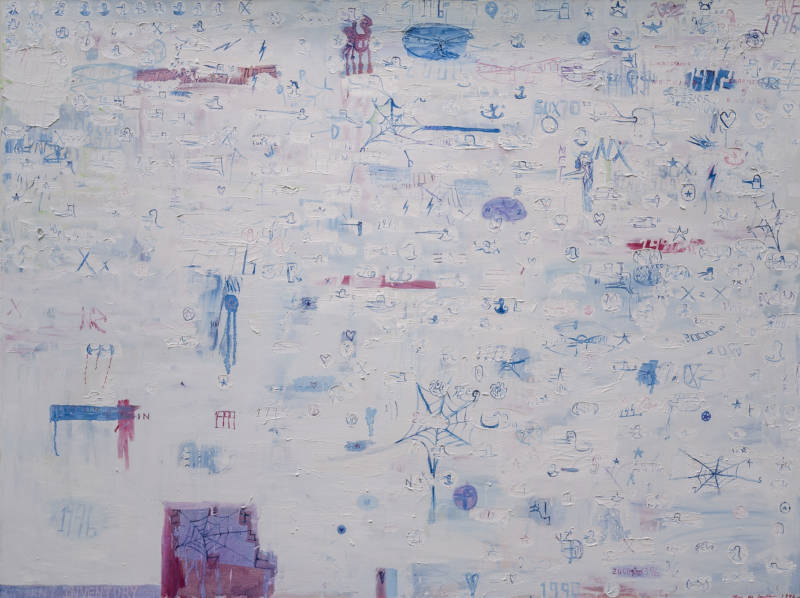
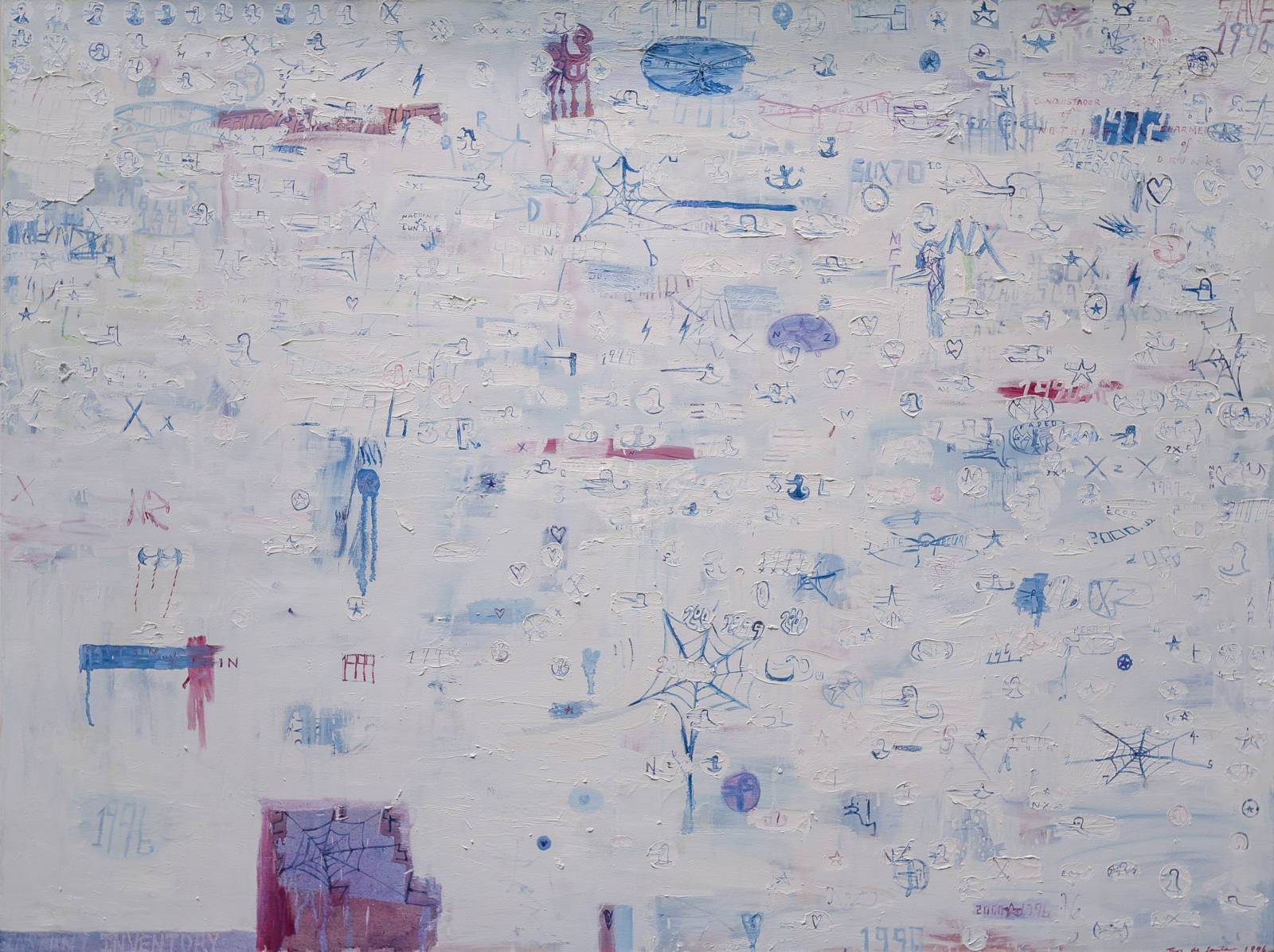
Instant Inventory is a typical example of de Lautour’s work from the mid-1990s: huge, thickly-worked impasto paintings with symbols scratched into the surface, much like graffiti scratched into the back of a bathroom door. Even though they often look naive or humorous, de Lautour used these symbols and styles to explore serious questions around the cultural identity of Aotearoa New Zealand.
In this painting, we see bird-like heads—like a kiwi cartoon character—repeated over and over across the canvas. This kiwi character appeared often in de Lautour’s work, sometimes drawn with devil horns, holding a weapon, making rude gestures, or stomping across the land like a feathered Godzilla. Even though the kiwi looks silly and comic, it can also be seen as a symbol of our national identity gone wrong, something familiar that’s been corrupted.
With so many bird emblems scattered across the canvas—mixed in with Xs, love hearts, lightning bolts, and random words or phrases (often taken from songs he was listening to at the time), all painted in the faded blue of an old tattoo—de Lautour’s message isn’t immediately clear. There’s no single image that stands out. Instead, we’re encouraged to get up close and notice which symbols keep recurring, as well as how many words and images have been painted over with thick white layers, partly or completely hiding them.
Then there’s the title to think about: does Instant Inventory mean the artist is quickly taking stock of the symbols and ideas he’s been using? If so, the title is ironic—there’s nothing instant about this painting. De Lautour has worked in layers, sometimes completely covering what came before, other times letting earlier images peek through.
Another repeated motif in this work is the number 2000, four years in the future from the time of painting.

Provenance
1997–
Fletcher Trust Collection, purchased March 1997