WEEKS, John;
Winstone’s Yard
c.1920
Oil on linoleum on board
225 x 275mm
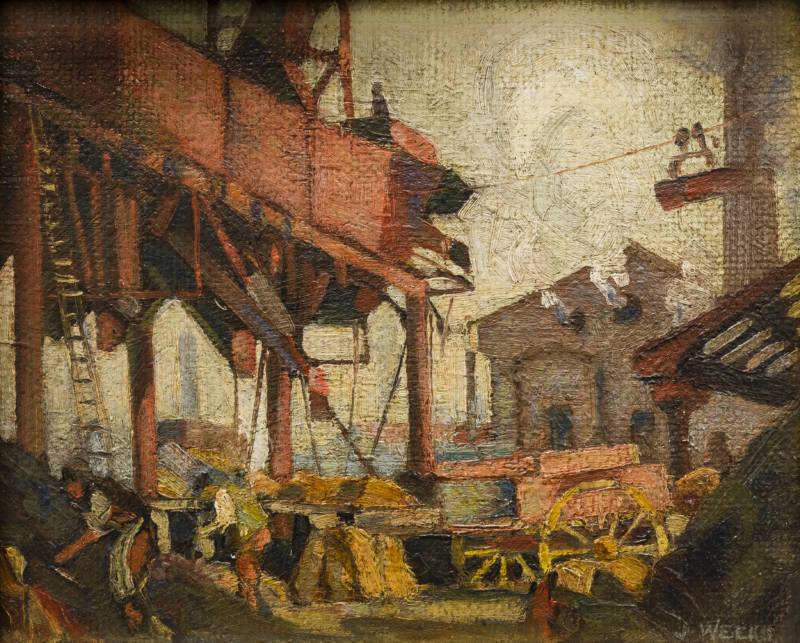
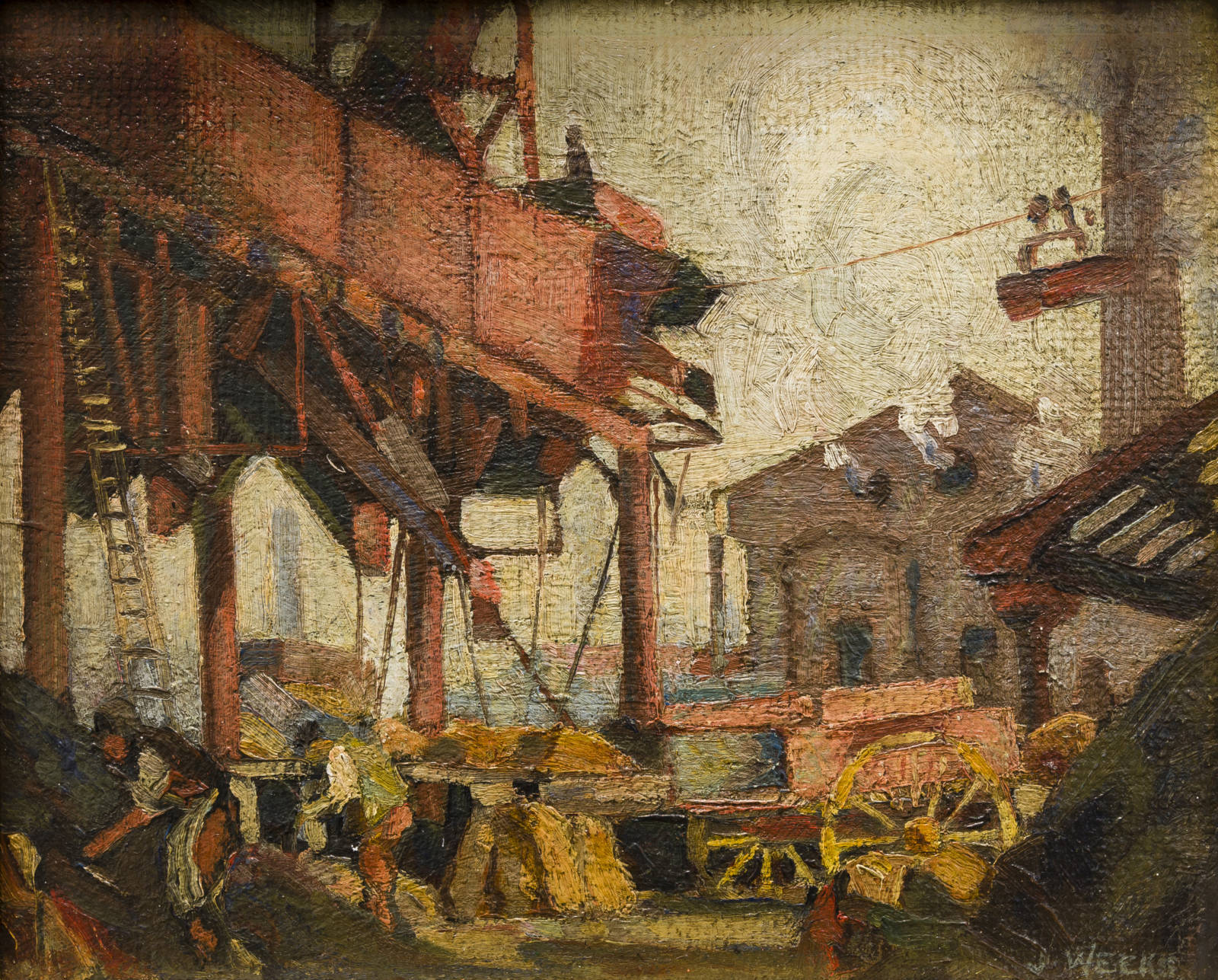
Kyla Mackenzie, the leading authority on John Weeks, has extensively discussed his interest in industry. The Fletcher Trust Collection holds two significant examples: Old Brick Works, from about 1940, and Winstone’s Yard. She has called this work ‘a small composition but with monumental effects’, noting:
‘At the left stands a curious multi-legged industrial beast; a metal crusher used in the roading industry, which fills much of the composition. The scene Weeks produces does not spell itself out. It seeks a register of awe and contemplation in the viewer, despite the ‘banal’ man-made subject, but which is nevertheless akin to the terror, obscurity, and ‘vast power’ suggested by a subject of the Sublime. An industrial sublime is invoked partly through the expressive differences of scale: two dwarfed men bend in unison, while the building belches smoke, and a crate swings to the right. Weeks’ industrial subject is rendered with theatrical overtones. Smoke or steam billows forcefully from the oculus windows of a distinctive building, the slightly rounded flurries merging seamlessly with a silvery yellow pale sky. An act of unseen energy, power, and transformation is occurring which contributes to the picture’s mystery.’
‘The composition is eventful: a unified palette of ochres, greys, red and apricot orchestrate repeated verticals, diagonals, and irregular angularities. Rich morsels of deep red lead the eye around the composition. Deep amber defines different units of a foreground worker. The men are not only subservient to their mechanical beast; they are small units in an ‘all-over’ composition of orchestrated colour, tone and line. The central pole of the rig converges with the horizontal stretch of clay-coloured timber, further highlighting this central zone as an area of interest. The cart is loaded with timber and reminiscent of a wheel-run cannon. The pinky-hued ‘cannon’, in this conflated space, points directly at the male workers. Weeks often manipulated his objects, such as bread knives or fruit in later works, to act like visual conductors. But, in his smoky scene of industry there are violent echoes of the recent war.’
‘… Weeks has been appropriately credited with encouraging the use of modern work-sites as a subject worthy of art, though the extent of his preoccupation has not been explored. He took up the subject in a country most comfortable with the landscape as artistic theme. Painters who explored the forms of working industry and infrastructure include Christopher Perkins, Rita Angus, Doris Lusk, Charles Tole, Wilfred Stanley Wallis, Douglas MacDiarmid, Melvin Day, Louise Henderson, Peggy Spicer, and Ida Eise. Some of them were mentored by Weeks, including mature artist Elam teacher Ida Eise. In the 1930s, 1940s, 1950s, and very early 1960s, Elam students trailed after Weeks around central Auckland sketching the city wharves, the derelict shantytowns of Auckland’s central district such as Freemans Bay and Parnell, and the industrial yards and infrastructure of the city.’[1]
A work closely related to Winstone’s Yard, Winstone’s Yard, Freemans Bay, Auckland, is in the collection of the Arts House Trust. It is larger and was ostensibly painted several decades later, testifying to Weeks’s habit of revisiting compositions as well as his enduring interest in the site.
[1] Kyla Mackenzie, ‘Eclecticism and Continuities: A Thematic Approach to the Oeuvre of John Weeks’ (PhD thesis, University of Auckland Waipapa Taumata Rau, 2018), 94–98.

References
Kyla Mackenzie, ‘Eclecticism and Continuities: A Thematic Approach to the Oeuvre of John Weeks’ (PhD thesis, University of Auckland Waipapa Taumata Rau, 2018), 94–96, passim.
Provenance
1991–
Fletcher Trust Collection, purchased from John Leech Gallery, Tāmaki Makaurau, November 1991
–1991
Unknown