ILLINGWORTH, Michael;
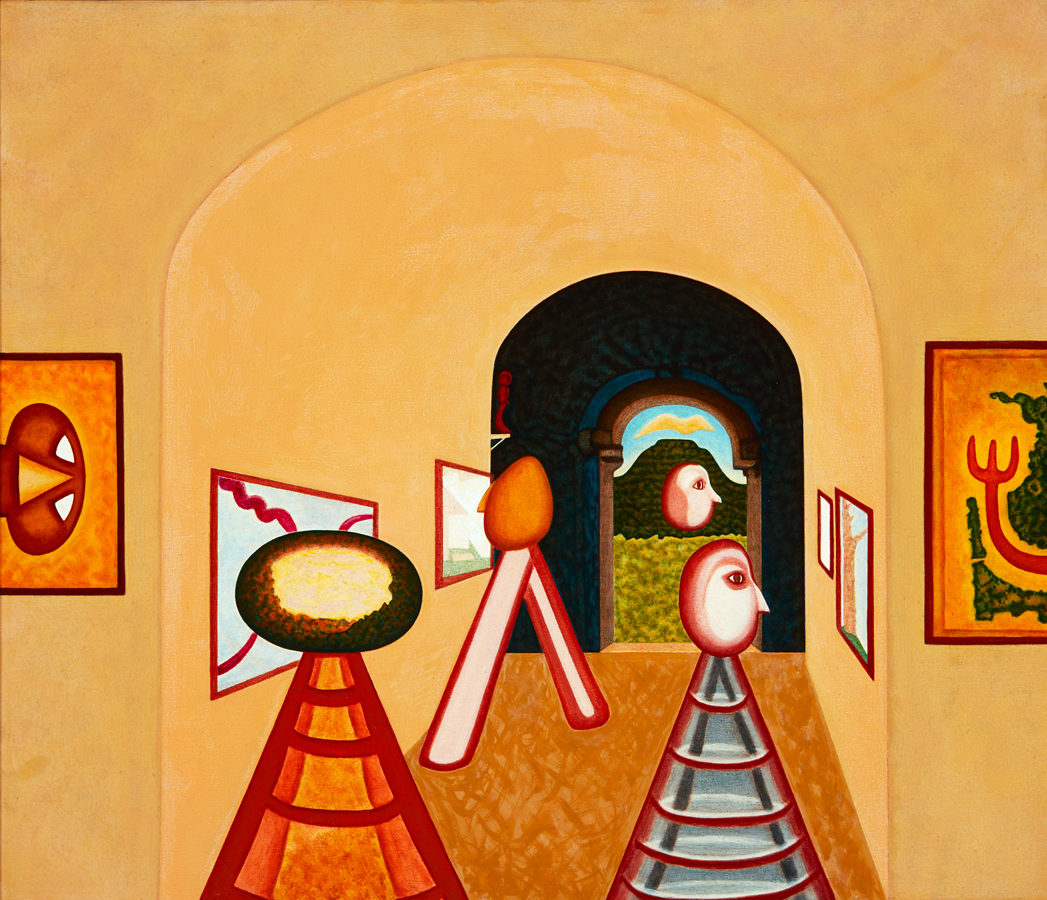
The Gallery Goers
c.1970
Oil on canvas
610 x 715mm

Lucinda Bennett
Michael Illingworth is a New Zealand artist known for his bold, imaginative paintings that often used symbolism to explore big ideas about life, identity, and society. Born in 1930, Illingworth developed a distinctive style that mixed surreal landscapes with cartoon-like figures, drawing attention to issues such as human vulnerability, power, and the pressure to conform.
One of his most famous symbols is the “Everyman” figure—a simplified, faceless male body often shown naked and alone. This character represents ordinary people and how they are shaped (or trapped) by the world around them. Illingworth also used rich colours, strange creatures, and dreamlike settings to encourage viewers to question authority, challenge social norms, and think about what it means to be free and human in modern society.
The Gallery Goers looks specifically at the art world, showing a gallery space filled with versions of Illingworth’s own paintings—a technique called mise en abyme, or a painting within a painting. This clever trick makes us think not just about what we’re looking at, but whether we’re also part of the scene—and if we are, what does that say about us?
The visitors in the gallery aren’t realistic people—they’re strange, robot-like figures with no arms or legs. Their bodies resemble Victorian cage-like skirts or Daleks, the emotionless, rule-following alien villains from the TV show Doctor Who. These figures symbolise people in the art world who blindly follow trends or act with no individuality. Illingworth is using humour and exaggeration to question how people behave around art, and perhaps suggest the way they lose their ability to think for themselves.
Even though the painting is humourous, Illingworth includes himself in the joke. He’s not just criticising others, he’s also reflecting on his own fame and success: Illingworth made local art history when in 1967, he sold out an entire exhibition of paintings during the opening, something that had never happened before in Aotearoa. The Gallery Goers is both a joke and a serious comment, using symbolism to explore success, conformity, and how we experience art today.
Laurence Simmons
In the depiction of a space that could possibly be the old Auckland City Art Gallery Illingworth has placed images of his own paintings within his painting. In so doing he has drawn upon the formal technique of mise en abyme: paintings that bear within themselves a miniature reflection of themselves. The effect of the en abyme is at once theoretical and reflective. Firstly, that somehow looking at the paintings within this painting we might wonder in whose painting we find ourselves? It engenders the suspicion that we all live as simulacra among simulacra under the ubiquity of the regime of representation. All the world is a gallery, just as, in another twist of the structure, Shakespeare suggested it was a stage. Secondly, painting that self-reflection raises to the second and third power like this suggests we find ourselves forever poised dizzingly on the abyss (abyme) of bottomless duplication. Like nesting Russian Matroyshka dolls. Nevertheless, the painting within the painting gives the artist the opportunity of presenting variants of his previous subject matter, and it is another form of the ‘compartmentalisation’ which was a signature of Illingworth’s style. Illingworth’s art appreciators are armless and legless. Their bodies appear to be something like the cage crinolines which produced the huge, volumnous skirts so often associated with mid-century Victorian fashion, and were made of flexible sprung steel rings suspended from fabric tape. And in another more contemporary allusion they are versions of daleks, the extra-terrestrial race of mutants that appeared first in 1963, conceived by science-fiction writer Terry Nation for the television series Doctor Who. What does it say about art lovers that the daleks were merciless and pitiless cyborg aliens, demanding total conformity, with little, if any, individual personality, and ostensibly no emotions other than hatred and anger? We still use the term metaphorically to describe people, usually authority figures, who act like robots unable to break from their programming. Daleks behave like toddlers in perpetual hissy fits, gloating when in power and flying into rage when thwarted. They tend to be excitable and will repeat the same word or phrase over and over again in heightened emotional states, most famously ‘Exterminate! Exterminate!’ Sound like an art critic or collector you know? A (public) gallery of his own work is also Illingworth’s wry reflection on his own moment of astounding critical and commercial success when his 1967 exhibition at Barr Let Galleries made New Zealand art history by selling out at the opening. This was a moment when his sinecure became known outside the art world in the popular press and the buzz around sales had his collectors tumbling over each other. Characteristically, Illingworth’s reaction to the onsite New Zealand Herald photographer was to show the fingers. And he does it here again in this painting with its deadpan satirical tone of supreme confidence, the pumpkin cast of the gallery walls invests the scene with the dreaminess of a fairyland comedy. It would not be incorrect to suggest that most of Illingworth’s paintings are still lifes, this is his fundamental genre. His people are objects. He arranges them. Everything, including the landscape (is that Rangitoto at the rear?), seems imported from somewhere and put in place on the walls, which is, of course, exactly what an art gallery does. Satire takes a grim, or not so grim, satisfaction in demonstrations of human vacuousness. It had a major pictorial philosopher in Illingworth, who calmly implicates himself, and his art, in a critique of what he called ‘the establishment façade’. Things haven’t changed and present-day ‘art-going’ is still a lot more like Illingworth’s painting than I wish it were.

Provenance
2017–
Fletcher Trust Collection, purchased December 2017
–2017
Collection of the artist and his estate, offered as part of The Estate of Michael Illingworth, Art + Object, Tāmaki Makaurau, 14 September 2017, lot 44